Statue of Alaric
Near the confluence of the Crati and the Busento
According to the historian Jordanes, the Goths diverted the Busento to bury their king Alaric in its bed; he died near Cosenza between 410 and 411. The tomb has never been found; since 2016 a sculpture by Paolo Grassino recalls the myth.
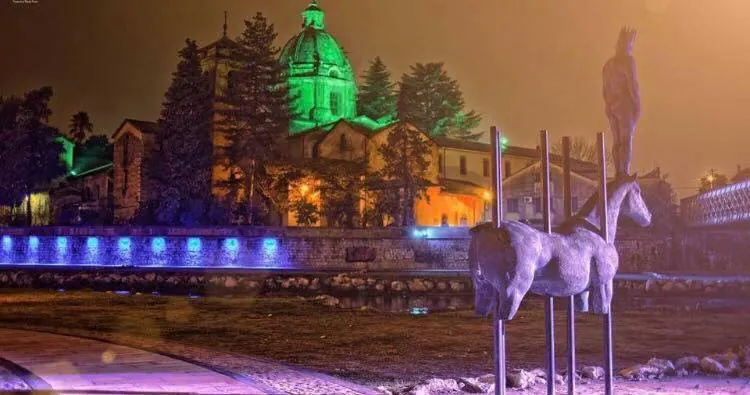
The story
Alaric, king of the Visigoths, sacked Rome in August 410. He then headed south, meaning to cross to Sicily and on to Africa, but a sudden death stopped him near Cosenza: between late 410 and early 411, according to scholars. That much is solid. The rest comes from Jordanes, a sixth-century historian, and remains legend: the tomb has never been found.
According to Jordanes, his mourners turned aside the Busento and had a gang of captives dig the grave in the middle of the riverbed. They laid the king there with many riches, let the water flow back into its course, and killed the diggers so that no one would ever learn the spot. Jordanes names the Busento; local tradition places the tomb at the confluence with the Crati. Close by, since 5 November 2016, stands Paolo Grassino's sculpture.
What to look for
Take a close look at how it is built: the wounded, legless horse is lifted on four tube-like stilts, like a children's carousel (the artist's own image), and a skin of raised lines covers horse, king and supports alike. The warrior king stands upright, joined to his steed by his feet.
In the story
Curiosities & Secrets. Things almost nobody knows, even if they walk past them every day.
Before you go
Opening hours and entrances can change: check on Google Maps or on the spot before you set off.
The old town is explored on foot and has a few climbs: how to get here and around.
Sources
Texts built on public sources. Where sources disagree we say so; if you spot a mistake or have an extra document, write to us.
- Comune di Cosenza - La statua di Alarico di Paolo Grassino, già posizionata alla confluenza dei fiumi, sarà inaugurata ufficialmente il 5 novembre in Italian comune.cosenza.it
- Comune di Cosenza - Sabato 5 novembre l'inaugurazione della scultura di Alarico in Italian comune.cosenza.it
- Il Lametino - Inaugurata a Cosenza scultura dedicata ad Alarico in Italian lametino.it
- Il Quotidiano del Sud (5 nov 2016) - Cosenza, svelata la statua in onore del re dei Goti Alarico in Italian quotidianodelsud.it
- Panorama - Cosenza inaugura la statua di 'Alarico a cavallo' in Italian panorama.it
- LaC News24 - Cosenza, domani inaugurazione della statua di Alarico in Italian lacnews24.it
- Jordanes, Getica (testo latino) - The Latin Library in Latin thelatinlibrary.com
- Treccani - Alarico I in Italian treccani.it
- Alarico I - Wikipedia in Italian it.wikipedia.org
- Alaric I - Wikipedia en.wikipedia.org
This place is part of
Do you have a story, a vintage photo or a correction about «Statue of Alaric»?
We would love to hear it.